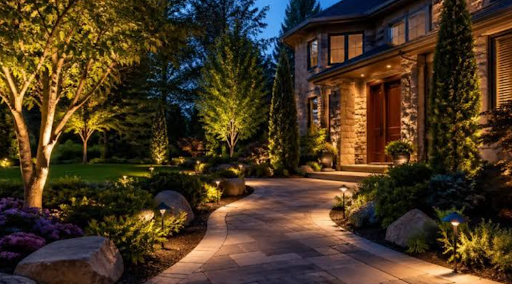
Good outdoor lighting is one such thing which nobody notices until the moment it has gone wrong. At that very moment, most people begin to search for outdoor lighting experts, since picking a few fixtures off a shelf is not enough to get things right. More than that is needed, understanding how light behaves once outside, knowing which materials truly survive years of rain and sun, and figuring out where things must sit so that a garden or an entryway ends up feeling warm rather than washed out. Such knowledge comes only after doing the work many times over, reading about it alone will never be enough.
What Actually Goes Into Outdoor Lighting?
Far more happens here than a switch being flipped once dusk arrives. Each of pathway lights, deck lighting, garden spotlights and security fixtures carries its own separate job. Guiding feet safely without blinding anyone, that is what a path light must manage. Making a tree or a shrub look attractive rather than flat, this falls to the garden spotlight.
On the practical side, things are not so simple either. Moisture, heat, cold, and constant exposure, all of this must be handled by outdoor fixtures in a way indoor lighting is never asked to. Should the materials or seals not be right, failure tends to arrive quickly, at times inside of a single season even.
Does Better Lighting Actually Make a Home Safer?
Indeed it does, and this happens to be among the biggest reasons why people take the trouble at all. Accidents like to occur at dark steps, uneven driveways, and hidden side gates most of all. Fixing most of that trouble often needs nothing more than a handful of well placed lights.
Typically included in a safety focused setup are things like below:
- Light kept steady along walkways, so that guessing the next step becomes unnecessary
- Entry lighting strong enough for recognising faces, yet not so strong that it turns into an interrogation feeling
- Motion sensors fitted close to doors and gates
- Those dark corners which every yard tends to have somewhere, covered properly
A stadium look is not required for any of this. When the work is done properly, calm and secure is simply how it feels.
Why Placement Matters More Than Brightness
A common mistake many people make is this: assuming brighter always means better. That assumption is wrong. Placing a strong light at the wrong spot only brings glare, odd shadows, or turns a space harsh instead of welcoming.
Everything changes according to a fixture’s angle and its height. From below, lighting a tree gives a bold, dramatic outline as result. From above though, the same tree ends up looking closer to soft moonlight coming down through branches. Which effect belongs to which spot is not something guessed at randomly, this comes only from testing lights outdoors, night after night, repeatedly.
What About Energy Use?
LED is what most outdoor setups run on these days, and for good reason too. Only a fraction of what older bulbs consumed is used by them, plus they last for many more years, so climbing ladders less often to change bulbs and paying lower bills over time becomes possible.
Different colour temperatures also come with LEDs. For a relaxing patio or a garden seating area, warm tones suit best. Driveways or utility spaces needing only clear visibility, cooler tones serve better there. Feeling cold and clinical is what happens to an otherwise nice space when the wrong tone gets chosen.
Does the Season Change What Lighting You Need?
More than most would expect, yes it changes. Longer nights arrive with winter, meaning lights switch on earlier and stay lit for more hours, with warmer tones feeling cosier across that stretch. Toward evening spaces instead, summer shifts the focus, patios, dining areas, places used mostly once the sun has already gone down.
Whatever weather the year brings must be handled by fixtures regardless, though small adjustments made to timing or brightness through the seasons keep a space feeling correct no matter which month arrives.
Why Timers and Sensors Are Worth Having
Timers, sensors, or smart controls come already built into a lot of outdoor lighting nowadays. Guesswork around turning lights on and off daily gets removed by these, plus wasting electricity on lights running while nobody is around gets avoided too.
Particularly near entrances or side paths, motion sensors prove useful, lighting up only once movement occurs, practical in nature while also serving as a nice little bonus toward security.
Final Thoughts
Safety, design, and a bit of technical know how, this is what outdoor lighting really comes down to in the end. Where a single fixture sits, what tone the bulb carries, when exactly the lights switch on, choices small in themselves, yet together deciding whether a space feels wonderful or falls completely flat. For this very reason, calling outdoor lighting experts is what so many homeowners choose over figuring things out alone, because getting that balance right, season after season, remains a skill built only through real experience, never through guesswork.